


Today’s newsletter (Issue #623) takes stock of the CCHA at the semester break, including why it’s shaping up as a six-team race for the top spot in the league. It also examines just how close Lake Superior might be to breaking through.
Also in today’s issue, Colorado College made the addition of defenseman Mats Lindgren official, and there is growing momentum among Division III athletic directors to allow former CHL players to gain eligibility.
If you have ideas for a future newsletter, tips you want to share, mailbag submissions, or if you want to sponsor a future newsletter, please email mike@collegehockeyinsider.com.
I’m also @MikeMcMahonCHN on Twitter.
Thank you to our premium subscribers for their support of independent sports media!
Now, onto today’s newsletter …
Some things I think about the CCHA at the semester break
(1) Bemidji State, .694 points percentage
The Beavers went into the break 0-3-1 over their final four games, but context matters. Three of those came on the road, and the opposition included North Dakota and an Augustana team that has been trending up for the better part of a month.
There’s offensive punch at the top of the lineup, and defensively they’ve been sound. If there’s an area that could use tightening, it’s the penalty kill. Even so, this looks like a group that should be firmly in the mix near the top of the league standings come March.
(2) Minnesota State, .667 points percentage
The loss to Ferris State on Dec. 6 stands out as the lone real blemish on Minnesota State’s résumé since Nov. 1. They followed that with a 3-1 loss at Augustana on Dec. 12, but given the way the Vikings have been playing, that’s not a result that necessarily stings.
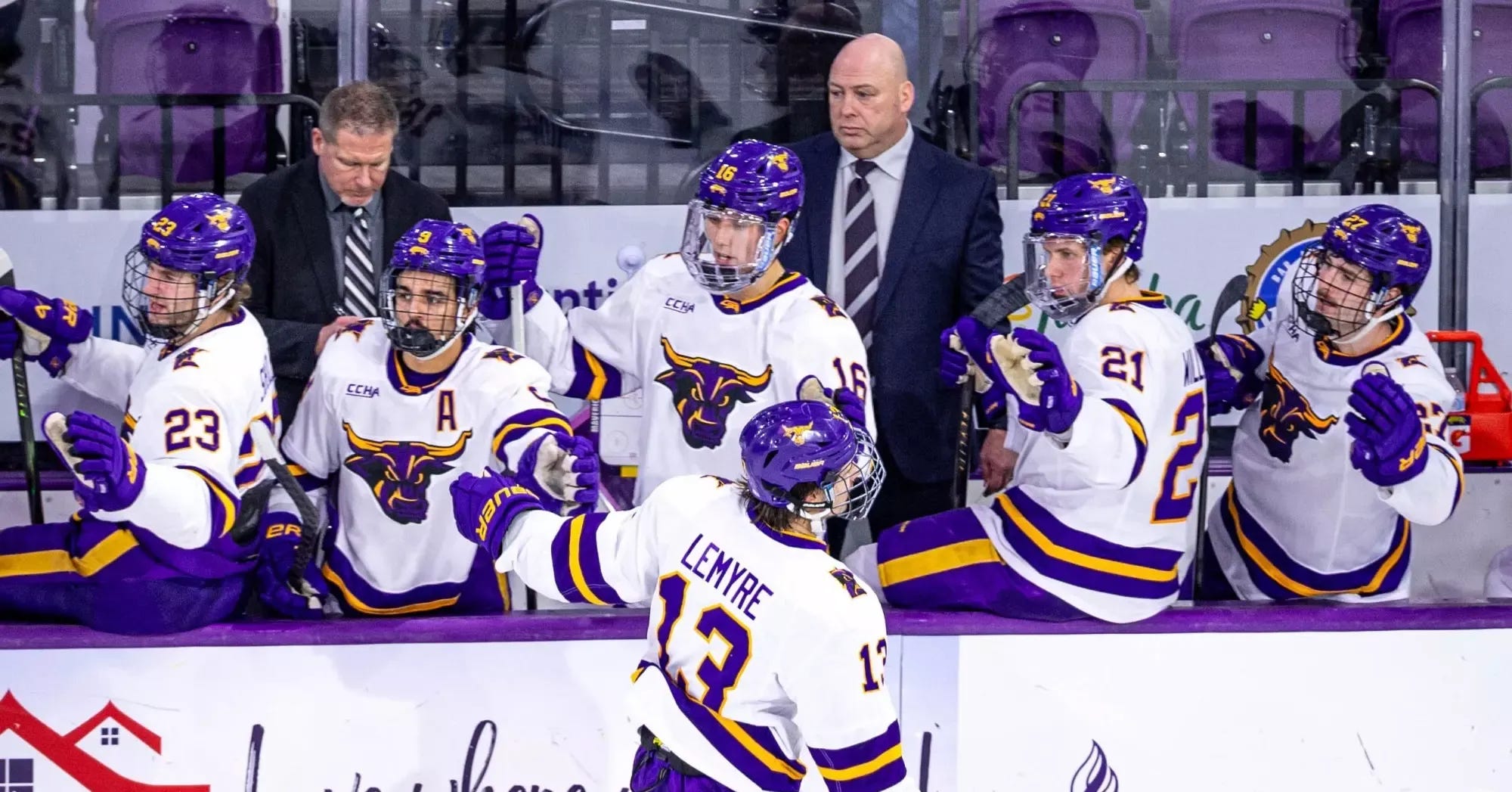
Offensively, the Mavericks are a bit top-heavy, with Tristan Lemyre accounting for nearly 20 percent of their goals (17.8 percent). At the other end, Alex Tracy has continued to be a difference-maker between the pipes (1.92 GAA, .929 save percentage). This is a team built to win 3-2 games — and they’re very comfortable living in that space.
I know how they want to play. Opponents know how they want to play. It’s not a secret. They just do it better than a lot of teams.
(3) St. Thomas, .636 points percentage
The Tommies had a rough start to the season. There’s really no way around it. October was a struggle, as they went 2-5-1 while surrendering 34 goals in eight games, an average of 4.3 per contest.
Since then, however, they’ve settled in, going 7-2-2 and allowing just 2.4 goals per game over that stretch.
Now that they’ve found their footing defensively, St. Thomas has a legitimate case to be the best team in the CCHA. They’ve also played the fewest games in the league (11), with three games in hand on Minnesota State and two in hand on Augustana.
(4) Augustana, .615 points percentage
The Vikings dropped just one game in December (3-1-2) and have been rolling since Thanksgiving. That run includes challenging matchups against other league heavyweights, including Bemidji State and Minnesota State.
They’ll be at home frequently in January — six of nine games — which could provide an opportunity to make a push toward the top spot in the standings.
(5) Michigan Tech, .611 points percentage
Goaltender Owen Bartoszkiewicz has been a significant difference-maker for the Huskies, posting a 2.23 goals-against average and .920 save percentage through 17 starts.
From a goal-differential standpoint, Michigan Tech’s numbers aren’t dramatically different from last season, but the results are. At the break, they’re already 63 percent of the way to last year’s win total.
To me, the biggest difference has been timely saves and timely goals. A lot of that comes down to confidence, and the new coaching staff deserves credit for fostering that environment. It didn’t always feel like that was the case a year ago, when this group often looked tight and hesitant, almost playing afraid to make a mistake.
This version of the Huskies looks more comfortable. That matters. Even trailing Ferris State late on Dec. 12, they didn’t look rattled, scoring twice in the final minutes of the third period to pull out a win. It hasn’t been flawless, but it’s clearly a different group.
(6) Bowling Green, .583 points percentage
It’s shaping up as a six-team race at the top of the league, and while Bowling Green has some ground to make up compared to teams with higher point percentages, they’re very much in the conversation.
The challenge in January will be doing it on the road. Four of their six league games this month are away from home, and they’ll need to navigate that stretch effectively to keep pace.
(7) Lake Superior, .333 points percentage
The Lakers are a team that just can’t quite get over the hump. They’ve been “right there” in a lot of games, yet head into the break 6-11-1 overall and 3-9 in league play.
Half of their games have been decided by a single goal, and they’re 3-6 in those contests. The competitiveness is there; the ability to close hasn’t been, at least not consistently in the first half.
(8) Ferris State, .222 points percentage
Ferris State is in a rebuild, so the early results aren’t entirely surprising. That said, they’re better than the record suggests. In watching them a handful of times in the first half, there were signs of progress, particularly heading into the break, when they played Michigan Tech tight and picked up a win over Minnesota State.
(9) Northern Michigan, .111 points percentage
The Wildcats finally broke through with a win over Bowling Green on Dec. 5, but that remains the lone victory entering the break (1-19-0).
Scoring has been a major issue at 1.7 goals per game, and defensively they haven’t fared much better, allowing 4.0 per contest. At five-on-five, they rank 60th nationally in goal share (31.5 percent) and 61st in shot share (40.5 percent).
The program was hit hard when Grant Potulny departed for the AHL. Key recruits exited the pipeline, and several top players entered the transfer portal. A rebuild was inevitable, and it’s a long road back. It also doesn’t help that programs in Northern Michigan’s position — and others like them — are increasingly challenged in an environment where some teams are paying players five figures to play on the second or third line.
Notebook: CC makes Lindgren’s addition official, Division III adding CHL players
— Colorado College made the addition of Mats Lindgren official. We previously reported on Lindgren joining the CC roster for the second half on Dec. 19.
Lindgren is the son of former NHLer Mats Lindgren and was selected by the Buffalo Sabres in the fourth round of the 2022 NHL Draft, though he went unsigned and later became an unrestricted free agent.
The 21-year-old defenseman split last season between the Wheeling Nailers of the ECHL and the Wilkes-Barre/Scranton Penguins of the AHL, recording 21 points (7 goals, 14 assists) in 56 games with the Nailers.
In his final junior season with the Rebels in 2023–24, he posted 41 points (7 goals, 34 assists) in 63 games.
CC head coach Kris Mayotte said last week it was likely defenseman Max Burkholder will miss the remainder of the season, making Lindgren’s addition a timely one.
— There has been growing movement in Division III hockey toward the future acceptance of CHL players.
As is now well established, CHL players became eligible for Division I hockey last season following a change to Division I legislation. Division III programs, however, are governed by a separate legislative process and did not adopt the change concurrently, meaning only Division I programs can currently accept former CHL players.
That could change. There is now a push among several Division III athletic directors to implement the adjustment at the Division III level for the 2026–27 season.
One Division III coach told College Hockey Insider this week, “It’s inevitable. I think it will change for 2026-27, but if not, definitely 2027-28.”
As with Division I, this would have a significant impact on recruiting and, by extension, the junior hockey landscape.
My sense is that the new ecosystem would shake out something like this:
Tier I: USHL, OHL, QMJHL, WHL: Feeding Division I and the top tier of Division III.
Tier II: NAHL, BCHL, etc.: Feeding Division III and top-end ACHA club programs.
Tier III: NCDC, EHL, SJHL: Feeding some Division III programs and many ACHA club teams.
A player, for example, could be recruited out of the BCHL, move to the WHL, and still end up playing Division I hockey. I’m referring specifically to a player’s league or level in the season immediately preceding NCAA enrollment.
The change still must navigate the legislative process. The NCAA Division III Council will need to formally approve it, with the next opportunity coming during its meetings next month at the NCAA Convention. Those meetings are scheduled for Jan. 13–16 in Maryland.